
For most of our lives, we are taught to think about health in binary terms.
You are either healthy or sick.
Fine or not fine.
Clear or diagnosed.
1 or 0.
This mental model is everywhere.
It shapes how we talk, how we worry, how we postpone attention.
It is reinforced by medical language, insurance logic, workplace expectations, and even casual conversation.
How’s your health?
I’m fine.
That answer feels complete.
It feels reassuring.
It lets the conversation move on.
It is also deeply misleading.
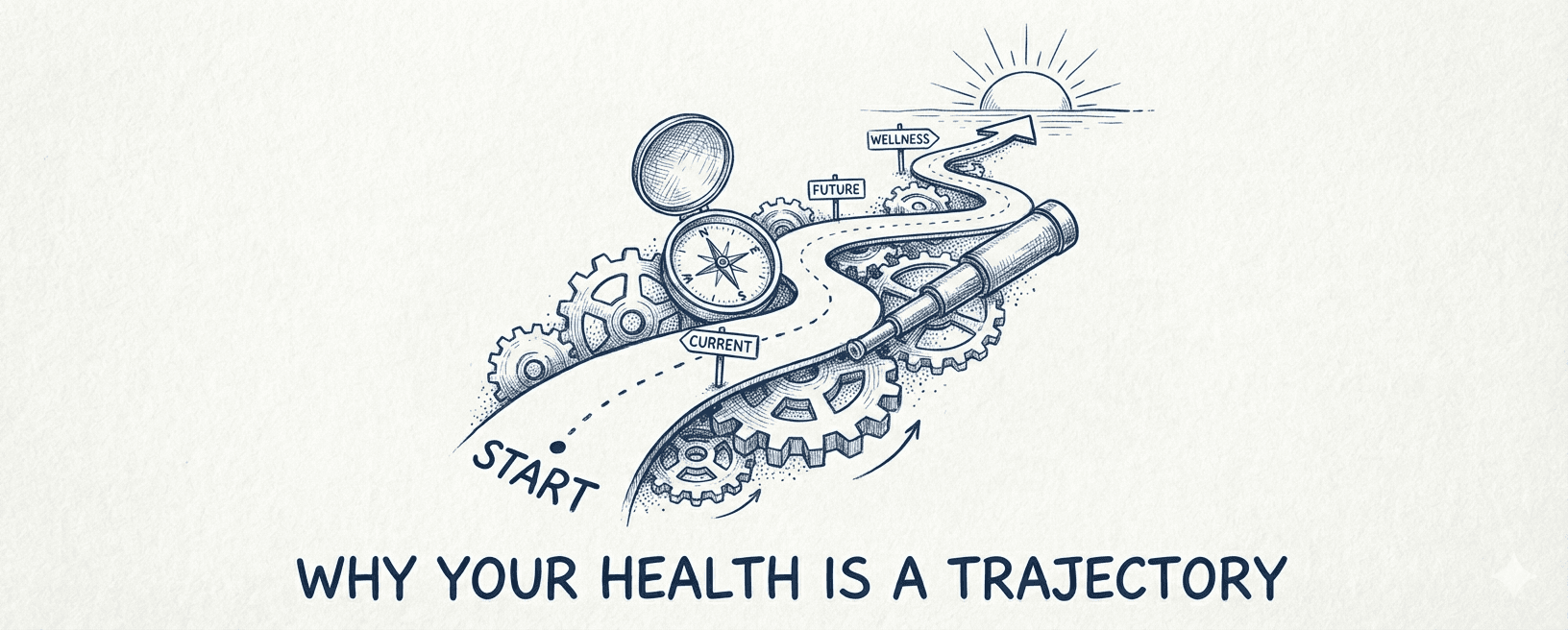
Health is not something you have.
It is something that moves.
And the moment you understand that, the entire system around health starts to look dangerously misaligned.
1. Why we think in binaries
Binary thinking is comforting.
It gives us clean categories in a domain that is otherwise uncomfortable, uncertain, and emotionally charged.
Healthy feels like safety.
Sick feels like a problem to be addressed.
Everything in between is vague — and vagueness is hard to live with.
Binary models also fit well with how modern systems operate:
- medical coding
- insurance reimbursement
- eligibility rules
- workplace policies
They require thresholds.
You cross a line, something changes.
You don’t, nothing happens.
From a distance, this looks efficient.
From inside a human body, it makes no sense.
Biology does not flip states.
It drifts.
2. How this mental model comforts us
The binary model offers psychological relief.
If you are healthy, you are allowed not to look too closely.
If you are sick, the system takes over and tells you what to do.
What it does not offer is responsibility during uncertainty.
The uncomfortable truth is that most meaningful health change happens in the space where:
- nothing is alarming
- nothing is diagnosed
- nothing forces attention
That space is precisely where the binary model tells you to relax.
You’re fine.
Everything looks normal.
Nothing to worry about.
These statements are comforting.
They are not insights.
They say nothing about direction.
They only say that no threshold has been crossed yet.
The model is wrong not because it is malicious, but because it is structurally incapable of representing gradual change.
3. Biology as a continuous process
Biological systems evolve continuously.
Cells adapt.
Hormonal balances shift.
Inflammation rises and falls.
Compensation mechanisms hide dysfunction.
The body is always negotiating, adjusting, responding.
There is no moment where health suddenly stops and disease suddenly begins.
What actually happens is:
- slow deviation
- long compensation
- eventual failure of adaptation
- late recognition
By the time something becomes an event, it has usually been a process for years.
Events are not beginnings.
They are endings we finally notice.
Any health model that treats events as origins is already too late.
4. Why “feeling fine” is a dangerous signal
Feeling fine is not a reliable indicator of health.
It measures how well your body is compensating — not how well it is functioning.
Humans are remarkably good at adapting to decline.
We normalize fatigue.
We rationalize pain.
We attribute subtle changes to age, stress, work, or bad weeks.
As long as life continues to function, we assume the system is stable.
But functionality is not the same as resilience.
Many serious conditions progress quietly precisely because the body shields us from early discomfort.
By the time symptoms demand attention, optionality is already reduced.
Feeling fine often means:
- the system is still compensating
- the cost is being deferred
- the trajectory is hidden
That is not safety.
That is latency.
5. The question we should ask instead of “Am I healthy?”
Am I healthy? is the wrong question.
It assumes a static answer to a dynamic system.
The better question is:
Is my health improving, stable, or degrading over time?
This question changes everything.
It shifts focus from labels to direction.
It acknowledges uncertainty without surrendering responsibility.
You do not need a diagnosis to ask whether something is moving in the wrong direction.
Direction is observable long before classification is possible.
6. What changes when you start thinking in trajectories
When you think in trajectories, several things change immediately.
First, silence stops being reassuring.
No news is no longer good news.
It is simply absence of signal.
Second, small changes become meaningful.
A trend matters even when values are “normal.”
Context replaces thresholds.
Third, decisions move upstream.
You stop waiting for permission to care.
You intervene earlier, more gently, and with more options.
Most importantly, responsibility returns to where it belongs —
not as blame, but as awareness.
Trajectory thinking does not create anxiety.
It reduces surprise.
And surprise is one of the most damaging forces in health.
7. Why modern healthcare is structurally incompatible with this view
Modern healthcare is not designed around trajectories.
It is designed around:
- visits
- tests
- episodes
- diagnoses
Time exists, but it is not the primary dimension of reasoning.
Each encounter is treated as a discrete unit.
History is reconstructed imperfectly, if at all.
This is not a failure of clinicians.
It is a failure of infrastructure.
Healthcare systems are excellent at responding to events.
They are poor at observing drift.
They wait for clarity that only arrives when intervention is already constrained.
Asking such a system to manage trajectories is like asking a snapshot camera to record a film.
The tool is not wrong.
It is just the wrong tool for the job.
8. Once you see health as direction, you can’t unsee it
Once you internalize that health is movement, not status, the old questions stop making sense.
Am I healthy? feels incomplete.
Waiting feels risky.
This perspective does not make health dramatic.
It makes it honest.
It does not demand constant action.
It demands continuous understanding.
Health was never a box you could check.
It was always a line you were moving along.
The tragedy is not that people get sick.
The tragedy is that we built systems that only notice movement when it is already hard to change.
This article exists to break that illusion.
Everything that follows builds on this idea:
Health is not something you have.
It is something you are becoming.
Once you see that, you don’t go back.
And you shouldn’t.
I’m building a healthtech startup to address this exact problem —
a long-term attempt to give health what it lacks today: continuity and time-aware intelligence.
I’m building this in public and documenting the entire journey.
If this way of thinking resonates:
- YouTube: https://federicofan.com/yt
- X: https://federicofan.com/x
- Why me: https://federicofan.com
A waitlist is open for those who want to stay close to the work as it evolves:
👉 https://uara.ai
Built slowly, on purpose.
Follow on: